I was reading up on Rachel Held Evans' superlatives blog and she quoted a post by Morgan Guyton that was reposted by Jesus Creed. I though it an interesting perspective on penal substutionary atonement theory running through conservative evangelical circles these days. Perhaps I'll write out some of my thoughts on the theory later...
Anyways, here's Morgan's post in full:
I’ve often wondered if the same thing that makes violent video games
appealing is why young evangelical guys are so infatuated with penal
substitution theology. I figure a scary bad-ass God is cool for the same
reason that the loud wet smack of a linebacker knocking the wind out of
a quarterback is cool (I was that linebacker once).
I recognize that some guys need to have a God who likes to say
“RAWR!!!” but in their zeal over penal substitution, some cringe-worthy
and not entirely Biblical assertions are being made. There is a
theologically responsible account of penal substitution; it’s part of
the mystery of the cross. But I wanted to examine four of the more
obnoxious assertions that I’ve heard in what I would call popular penal
substitution theology (in places like a recent Steven Furtick sermon I
listened to).
1) God is allergic to sin
A pillar of popular penal substitution theology is that God cannot
tolerate the presence of sin. I think it’s more accurate to say that sin cannot tolerate the presence of God.
The consequence of understanding things the first way is that the cross
becomes God’s inoculation for His sin allergy. Ironically, one of the
main points of Jesus’ incarnation was to prove that God is not distant
and untouchably pure, but rather someone who “eats and drinks with
sinners.” Now this doesn’t mean that sin is not allergic to God. People
reacted to Jesus’ perfect love and holiness either by repenting of their
sin like Zacchaeus did or by lashing out defensively and crucifying Him
like the Pharisees did.
It was not that Jesus couldn’t tolerate imperfection but rather that His perfection was intolerable.
In John 3:19, Jesus summarizes the relationship between sin and God’s
presence: “Light has come into the world, but men loved darkness instead
of light because their deeds were evil.” God is light; He doesn’t need
the cross to protect Him from our darkness; we need the cross so we can
survive entering into God’s light.
2) God sees Jesus instead of us when He looks at us
In the Steven Furtick sermon that motivated this blog post, he said
that the reason God gives us His “approval” is because He doesn’t see us
when He looks at us but sees Jesus instead. That’s not approval; that’s
deception. I can’t understand how anyone could possibly be encouraged
by that. God doesn’t need our true selves to be hidden from His view to
love us infinitely. His rage against the sin that oppresses us is part
of that love. It’s true that Paul tells us to “put on Christ” and says
that “in Christ we become the righteousness of God,” but Jesus isn’t a
mask that we wear to cover ourselves up; He’s a body in which we become ourselves.
Popular penal substitution theology perverts Paul’s theology because
it cannot recognize the sacramental character of the body of Christ from
its modern individualist ontology. Jesus is not just our brother who
stands in for us before God; He is also the one in whom “all things hold
together.” So the substitution Christ provides is really one-to-many
rather than one-to-one.
The phrase “in Christ” cannot be understood correctly without
recognizing that Christ was already the source of our being as the one
“in whom all things were created.” We are not truly ourselves outside of
Christ; we are accidental constructions of our social context. It is
only when we are “swallowed up” (2 Cor 5:4) by the life that Christ has
provided for us that we gain the freedom to be what God has always seen
in us. God doesn’t need to see a Jesus mask over our faces to approve
us; His unconditional prior approval of us is the reason He sent His
Word made flesh to empower us for holy living through our incorporation
into His body.
3) Since God is infinite, He is infinitely offended by the slightest of our sins
The legacy of penal substitution theology can be traced to a book called Cur Deus Homo
that was written by 11th century theologian Anselm to explain why Jesus
needed to be both divine and human. Being from a medieval honor-based
society, Anselm thought the primary problem resolved by the cross is the
offense that sin inflicts on God’s honor as a king. This became the
satisfaction theory of atonement which evolved into penal substitution.
Anselm reasoned that because God is infinite, someone who is also
infinite (Jesus) had to become fully human to pay the debt owed to God’s
honor by humans. Hence the God-man.
When I read Cur Deus Homo, I noticed an interesting phrase
that Anselm used to explain why it had to be this way. He says in
several places, “It is fitting.” He doesn’t say for whom it is “fitting”
that Jesus pays our debt to God. Does God need it to happen or do we? I think popular penal substitution theology conflates satisfying God’s honor with appeasing God’s anger. They are absolutely not the same thing. We
need for God’s honor to be satisfied through Jesus’ blood because
otherwise we would not be able to bear the shame of looking into His
face.
It is not that God is infinitely unable to understand the moral
complexity that is behind our sin. He sees all the mitigating
circumstances; He sees the good that we tried to do even in situations
where we were ultimately in the wrong. The problem is not that God is an
infinitely sanctimonious doosh bag who needed His Son’s blood to get
over His pickiness; then it would be a lot easier to make peace with the
dishonor we have shown Him. The problem is that we will be convicted
and sorrowed to the point of eternal torture to stand in the presence of
perfect love and truth without the assurance of Christ’s sacrifice on
our behalf. The peasants need the king’s honor to be satisfied;
otherwise they live in terror; and that’s why the king Himself paid the
price for their sin against Him.
4) God poured out His wrath on Jesus on the cross
The word wrath in Greek is οργή, the root for our word
“orgy” in English. When you look at how this word is actually used in
the Bible, it’s more mysterious than you might think. It’s not just a
synonym for “anger.” Paul tells the Ephesians that they were “formerly
by [their] nature children of wrath” (which the NIV theologically edits to say children deserving of
wrath). To be a child of wrath according to Paul is to be owned by “the
desires of our flesh and senses” (Eph 2:3). It has nothing to do with
God being angry.
In Romans 1:18, Paul writes that the “wrath of God is revealed from
heaven against all ungodliness and wickedness.” If wrath were simply
“anger,” we could expect Paul to elaborate on this statement by
cataloguing a series of natural disasters with which God responded
to punish humanity’s sin. Instead what we find is an account of the
degeneration of humanity through the innate consequences of their sinful
behavior. God “hands them over” to their lust, idolatry, etc, but He is
not actively punitive independent of these innate consequences in His response to sin. This seems to suggest that God’s οργή is the proliferation of sin itself.
When I read these texts, I wonder if we ought to think of wrath as
describing the poison that fills the air and curses the ground when God
is dishonored rather than an emotion experienced by a God whom we
probably shouldn’t presume to have the same kinds of emotions that we
do. In any case, what happened on the cross is that God the Father did not prevent
God the Son from being killed by the Jewish religious authorities. He
let Him drink the cup of (His/our?) wrath which He came to Earth to
drink. But this in no way means that the Father was the executioner of
the Son for the sake of His own anger management. When we talk about the
Father “pouring out His wrath” on His son, we make Him look like a
drunken child abuser.
I cannot find anywhere in scripture that makes the Father the primary
agent behind the crucifixion of His Son. The closest is the Suffering
Servant passage in Isaiah 52-53 in which we read that “it was the Lord’s
will to crush him with pain” (53:10). First, I would contend that the
Suffering Servant passage is primarily about Israel’s exile and only
secondarily about Christ in His
role as the recapitulation of His people’s destiny. The description of
the Suffering Servant cannot be mapped completely onto Christ without
compromising Christ’s divinity and the full unity of the divine will.
Secondly, in no place does Isaiah 52-53 describe the fulfillment of
God’s wrath as the purpose of the Servant’s suffering. Isaiah 53:5 says,
“Upon him was the punishment that made us whole; by his bruises we are
healed.” In other words, the purpose of the Servant’s punishment is our wholeness and healing .
It neither serves to fulfill God’s ego needs nor some primordial cosmic
free market principle of retribution that God is obligated to follow.
We are children of wrath; we are born into a world that sweeps us
into degenerative cycles of pain and guilt. “But God, who is rich in
mercy, out of the great love with which He loved us even when we were
dead in our trespasses, made us alive together with Christ” (Eph 2:4-5).
I just don’t see the cross having anything to do with God’s anger
though it absolutely does rescue us from the οργη that describes the
innate consequences of rebelling against God’s plan for us as creatures.
I really think that these problems in popular penal substitution theology might be a reflection of what Christianity Today
has called the “juvenilization” of American evangelical Christianity.
When church becomes youth group for adults, explanations that speak on a
teenage level become the norm for everybody.
When I was a teenager, the purpose
of being a Christian was to avoid punishment. I expected the rules to be
arbitrary and incomprehensible. So it made sense to me to accept a
savior who would rescue me from the clutches of the infinitely picky and
thoroughly uncompromising High School Principal of the universe. That
was the salvation I received when I asked Jesus back into my heart as a
16 year old (after I had already done believer’s baptism at age 8).
But I experienced the metanoia that is true repentance when
God spoke to me in 1998 through a little girl selling dolls in the
square of San Cristobal de las Casas in Mexico. He told me I could never
be a tourist again. That was when I gave my life to His kingdom. That
was when my heart was filled with wrath against all the ways that the
world dishonors a God whose image was reflected to me through a barefoot
indigenous girl. I need God’s honor to be satisfied. I need the cross
not only for the sake of my personal relationship with God but because I
cannot live in a world where the crucified are not resurrected. Penal
substitution is an important part of the rich mystery of the cross —
just not in the oversimplified, canned version that has come to
predominate our juvenilized evangelical church.
Showing posts with label theology. Show all posts
Showing posts with label theology. Show all posts
Monday, June 25, 2012


Friday, March 30, 2012
Why not Momma God?

For instance the image to the right is from the Sistine Chapel's ceiling. It shows God creating the sun and moon, and evidently God is an old man, probably Italian, who sports a long beard and unkempt hair. God of course doesn't look like this, nor is God Italian. God is depicted as temporal and material, both of which God is, wholly, not. There's Jesus, then again Jesus is not all of God, but one of three. Further, God is a man and God isn't a man, nor a woman. God is God.
Friday, October 28, 2011
in the Middle.
When I was in high school, Jimmy Eat World released a song, "The Middle", two things about the song... it was, and still is, very good and it was one of those songs a high schooler could connect to... because you know they're all the same, and you're very different.
 The concept jump back into my head recently. Because it's weird being in the middle. Home becomes very empty because it seems like there's only a few in the middle and it's intimidating trying to find those few in the middle without having to put some of your self on the line.
Here's the song by the way, because if you're anything like me once you get a song in your head you just have to listen to it: Jimmy Eat World "The Middle"
I can think of three areas in my life where I feel like I am predominantly in the middle. Identity, politics, theology.

Here's the song by the way, because if you're anything like me once you get a song in your head you just have to listen to it: Jimmy Eat World "The Middle"
I can think of three areas in my life where I feel like I am predominantly in the middle. Identity, politics, theology.
Friday, October 21, 2011
really just a few thoughts...
Thought Number 2:
 I had this idea of being a renaissance man. Kind of like da Vinci. Yet, the more I looked at the idea, the more I saw it as unfeasible... that is unless I never stopped education. I don't mean simply lifelong learning, I mean like paying to be taught and when I say never, I mean never.
Da Vinci had it "easy" the different areas of learning weren't nearly as stratified as now.
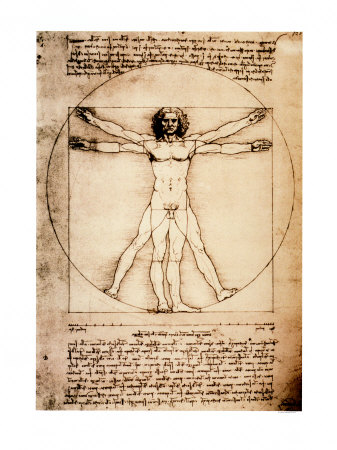
Da Vinci had it "easy" the different areas of learning weren't nearly as stratified as now.
Tuesday, August 2, 2011
So I saw The Adjustment Bureau...
 Alison and I watched The Adjustment Bureau on Sunday afternoon. It was a good decision, because it was an enjoyable movie and if we hadn't watched it we would have probably worked around the house and not rested... because there's nothing else to do, except for be on Facebook.
As enjoyable as the movie was, though, it kind of annoyed me, but only because I actually thought about it.... it's not as if there was any sort of glaring annoyance, it was just the theological undertones of the whole movie, which weren't veiled in the least... except calling God the "Chairman" and angels "agents" (if you want to call that veiling). Well, the one thing that was sort of a glaring annoyance was the cheesy explanation of how agents were able to use doors as portals.
If you haven't seen the movie I hope I don't ruin it for you, but I'm not going to reveal much in the way of the plot... so no worries.
Thursday, July 28, 2011
ideologue identity and I
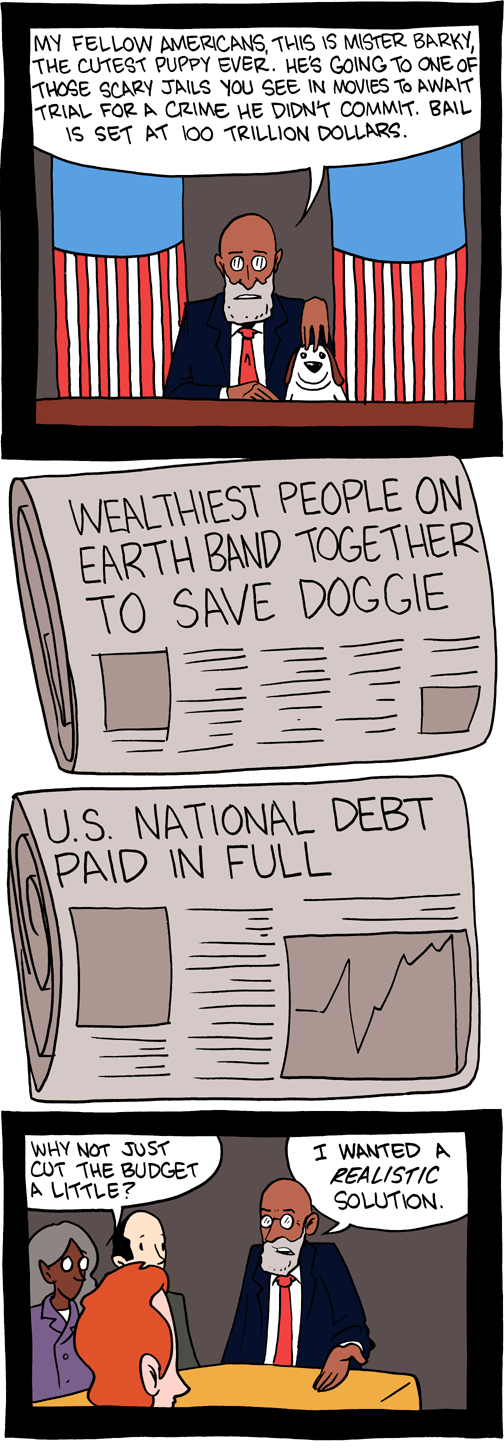 |
| I just thought this too funny to not put on here. |
I'm like most Americans, I think. This whole political brinkmanship, infighting and partisanship has bugged me since I actually started paying attention in undergrad. I suppose its no surprise that its come to this, I have a few friends who are hard-line and unforgiving in their ideology (or should I say dogma) on both ends of the spectrum. I hate talking politics with them, you can guess why... there is no room for them being wrong, not even in the slightest. They are ideologues.
I'm no foreigner to the mindset of an ideologue. I think I expressed the fact, even though never clearly stated, that I myself was an ideologue in several areas at one time. I have since grown out of that; at least I don't think I'm still an unforgiving, dogmatic to a fault ideologue. I am an idealist, yes, but I have been tempered by reality. (What does that make me an idealist realist, or a realist idealist?). Which means I know that I very well could be wrong in many things; I need only experience or reasoning far more sound (not louder) than mine to prove it, as has been proved in the past. OK, I guess I still can be an unforgiving jerk, but that's only because some people's reasoning is faulty... but does that make a a jerk or an ideologue? ...it's a rhetorical question, don't answer it.
Even still its difficult not to be an ideologue. We are all informed by ideals and, thus, an ideology. Even the apathetic are set on the ideal of apathy. And I find that my main qualm is with ideologues in the arena of theology/philosophy and politics...
Tuesday, July 26, 2011
i'm a cynic and a skeptic
It's true. I have increasingly become more and more cynical and I hate it.
It's because I am, at the same time, an idealist; this is an odd balance, I know.
To be honest I find it extremely frustrating, and I know I'm not the only one, thankfully. Recently, at my wedding, I was having a conversation with one of my groomsmen who had just graduated from grad school, essentially a seminary, with a degree in counseling. He said that he has increasingly become, like myself, a cynic, and also like me, hates it. It's a very frustrating view to have on life, the world and everyone you know. And yet, neither he or I can seem to fight it.
It seems like a loss of innocence or naivete, but I wouldn't call it that; I think it is more so the loss of ignorance and the frustrations that come when finite hopes become infinitely impossible to realize. I do still have hope, but I know that, in all likelihood, they will remain only hope and never become a reality.
It's because I am, at the same time, an idealist; this is an odd balance, I know.
To be honest I find it extremely frustrating, and I know I'm not the only one, thankfully. Recently, at my wedding, I was having a conversation with one of my groomsmen who had just graduated from grad school, essentially a seminary, with a degree in counseling. He said that he has increasingly become, like myself, a cynic, and also like me, hates it. It's a very frustrating view to have on life, the world and everyone you know. And yet, neither he or I can seem to fight it.
It seems like a loss of innocence or naivete, but I wouldn't call it that; I think it is more so the loss of ignorance and the frustrations that come when finite hopes become infinitely impossible to realize. I do still have hope, but I know that, in all likelihood, they will remain only hope and never become a reality.
Monday, May 2, 2011
love. Osama.
I’ll admit that, as of late, I am confused by those around me who are confused over whether or not they should be joyful over the death of Osama bin Laden or remorseful.
First I’d like to point out that in being remorseful one is saying that it is better for a man to live on encouraging actions of ungodly hate.
Second I feel like such a view is pushing beyond Christians' call to love. It is through Christ we are able to fully love God as well as fully love man. However, when something happens, such as killing Osama, are we to mourn over it? We are saying that what has happened should not have happened; that is saying what is better for the world is another type of world.
Friday, March 4, 2011
Reading of Scripture and Love Wins
So having a friend who went to Rob Bell's church, I myself liking Rob Bell, being a Christian, being in seminary and being rather familiar with the conservative, evangelicalsI have been not far from the debate about Rob Bell's new book Love Wins.
 Personally, I'm not much concerned about what he is saying right now; he has a new book coming out, which is sold by a publisher, a big one at that; publishers have to make money and so they hire marketing firms. If I were a marketing firm and I wanted to sell a book... I'd make controversy or get good reviews. Well, in the Christian world good reviews sell well, especially the classics, but nothing sells like an out in the open theological controversy; therefore, if I were a marketer I would make a controversy and props to HarperOne cause that's what they got and I guarantee you that everyone will either buy the book or borrow it; I mean they practically have to now if they care anything about the debate that is now in the public sphere.
 Personally, I'm not much concerned about what he is saying right now; he has a new book coming out, which is sold by a publisher, a big one at that; publishers have to make money and so they hire marketing firms. If I were a marketing firm and I wanted to sell a book... I'd make controversy or get good reviews. Well, in the Christian world good reviews sell well, especially the classics, but nothing sells like an out in the open theological controversy; therefore, if I were a marketer I would make a controversy and props to HarperOne cause that's what they got and I guarantee you that everyone will either buy the book or borrow it; I mean they practically have to now if they care anything about the debate that is now in the public sphere.
Tuesday, January 25, 2011
fear good
So I am scared of my future, it’s really no big deal.
In fact, I’m glad to say that I am, at least I’m a realist. I don’t think we are honest enough with fear. It’s like we want to cover it up, as if it’s bad. There seems to be something wrong with crying out and admitting to fear. We really are a bunch of liars; we go around showing strength and fortitude, and yet we are crying for answers and certainty.
For my Old Testament class we have to read all of the Psalms.
Wednesday, January 12, 2011
my doctrine on doctrine
Doctrine is great, it’s a great way to put theological beliefs and statements into memorable, "carry-on" formats. The Apostles’ Creed, Nicene Creed, Westminster Catechism, etc. all take big theological systems and put them into a simpler format. Which is a great thing for the church and the church people, it allows non-clergy to better know their own theology without having to have studied it for several years, and it allows the clergy to better teach it without teaching it for years. In this way it is fantastic.
Of course with this, and like many other things, I also have my disagreements with how it is used.
cold turkey ain't good turkey
One of the things that I am really against is cold turkey evangelism. I’ve done enough times to know that I don’t like it. Of course the argument for it is that you do it with the trust that God will somehow use it for his purposes. I agree with that, and when I do evangelize I am taking that to heart.
My problem is that it is simply a bad way to evangelize. It is wrought of love. Now of course I know that even taking the time to tell them about the Lordship of Christ is loving for me to do, but honestly how loved do they feel? If all I do is come up and share the gospel with them and then leave them at that what love would they feel? Would they feel loved that I took the time to come up to them to talk to them about Jesus? Maybe… if they were already Christian, but if they don’t know Christ yet then what? If it’s without some sort of continuing relationship what love is really given?
Loving should go hand in hand with suffering, and there is no suffering in cold turkey evangelism, there is persecution, but not the long suffering that Christ experienced. He spent 3 years with his disciples only to die without them "getting it" until he rose. That’s suffering, that expending yourself and not seeing any fruit. This is the sort of suffering that relational evangelism brings, not cold turkey. We should expect, and desire, to spend time with people, watch them sin, and never get it. We should expect them to deny Christ, turn away, make grandiose statements about his divinity and then in the next second be against Christ’s work. That suffering is much worse than merely being spat upon, that suffering breaks hearts.
I’d be willing to say that that is the model of evangelism that is set up for us. The gospel isn’t about getting people to convert, it’s about the Lordship of Christ enabling us to truly love and serve God, and, if we are doing that faithfully, conversion will happen whether we want it to or not. Just going out and throwing out the Word randomly is bad stewardship to. A farmer sure as heck doesn’t just randomly scatter seed, he does it with purpose and intent, some may fall on the path, but he is sowing seed in the field where he will be sure to tend to it.
We do have to proclaim it, but it’s different proclaiming a Messiah to people who are looking for one than to people who think they are their own Messiah. And if we are to proclaim it, it should be in the community that we live amongst, that we will be around daily or weekly, not to random people on the beach or a street that we probably will never see again.
Wednesday, December 15, 2010
turn it inside out
Christmas is awesome.
I love Christmas. I love Christmas music, and I love Christmas cheer, and "the best way to spread Christmas cheer is by singing loud for all to hear"- Elf.
I also love Christmas for the fact of little baby Jesus. Yes, he is our savior and that is way totally awesome, but it is so much deeper than that. It's ridiculous when you actually think about Christmas, like what went on. It's not just that Jesus was born, but it's that Jesus was born... am I confusing you?
Let me put it like this, Jesus, Son of God and God incarnate, was born as a human. That is impressive, and I think some get it, but many people don't get it. Pithy phrases like "Jesus is the reason for the season" just don't capture it. Most have this idea of Jesus being born in a barn to ultimately die for the redemption of humanity and this other idea of Jesus being one with the Father, and they never put two and two together.
This one thing has really been sticking out more and more to me lately, the sheer contradiction of Jesus a human and God a not-human. When God comes into this world as Jesus, God essentially became not-God. Think of it, God is omnipotent, omniscient, omnipresent, holy and glorious. Jesus is finite in everyone of those areas, he had finite power, finite knowledge, finite presence, was born and raised not by a priestly family of affluence, but by an poorer carpenter family - there's is nothing holy and glorious about that. The climax of the life of Jesus is even more ridiculous, he becomes sin; there is nothing more opposite of God than that. God came to earth as Jesus to essentially not be himself, not just be not himself, but the polar opposite.
This is not to say that Jesus couldn't have been more like a deity. Jesus most definitely had the capabilities, but Phil. 2:6 puts it like this "though being in the form of God, did not count equality with God a thing to be grasped." INCREDIBLE! Think of what Jesus could have been, but what Jesus was. He could have called on the angels to rescue him, but he didn't. He could have.... done well pretty much anything to make him more glorious, and yet he didn't. He remained a humble servant of not only God, but of humanity... the most high God became the most humble of creatures, and not only that but served them and is the sacrifice for them as well.
I just think its incredible that God turned himself inside out for us. He not only bent over backwards, but became not-God, he became opposite his nature and character just to rescue us. Why? It'd be like me becoming last so that I may be first, or leaving 99 sheep to find one. It is illogical and stupid, and yet its what God has done. God went off and got illogical; he became the very opposite of everything he was to open the gates of the kingdom for sinners like me.
I love Christmas. I love Christmas music, and I love Christmas cheer, and "the best way to spread Christmas cheer is by singing loud for all to hear"- Elf.
I also love Christmas for the fact of little baby Jesus. Yes, he is our savior and that is way totally awesome, but it is so much deeper than that. It's ridiculous when you actually think about Christmas, like what went on. It's not just that Jesus was born, but it's that Jesus was born... am I confusing you?
Let me put it like this, Jesus, Son of God and God incarnate, was born as a human. That is impressive, and I think some get it, but many people don't get it. Pithy phrases like "Jesus is the reason for the season" just don't capture it. Most have this idea of Jesus being born in a barn to ultimately die for the redemption of humanity and this other idea of Jesus being one with the Father, and they never put two and two together.
This one thing has really been sticking out more and more to me lately, the sheer contradiction of Jesus a human and God a not-human. When God comes into this world as Jesus, God essentially became not-God. Think of it, God is omnipotent, omniscient, omnipresent, holy and glorious. Jesus is finite in everyone of those areas, he had finite power, finite knowledge, finite presence, was born and raised not by a priestly family of affluence, but by an poorer carpenter family - there's is nothing holy and glorious about that. The climax of the life of Jesus is even more ridiculous, he becomes sin; there is nothing more opposite of God than that. God came to earth as Jesus to essentially not be himself, not just be not himself, but the polar opposite.
This is not to say that Jesus couldn't have been more like a deity. Jesus most definitely had the capabilities, but Phil. 2:6 puts it like this "though being in the form of God, did not count equality with God a thing to be grasped." INCREDIBLE! Think of what Jesus could have been, but what Jesus was. He could have called on the angels to rescue him, but he didn't. He could have.... done well pretty much anything to make him more glorious, and yet he didn't. He remained a humble servant of not only God, but of humanity... the most high God became the most humble of creatures, and not only that but served them and is the sacrifice for them as well.
I just think its incredible that God turned himself inside out for us. He not only bent over backwards, but became not-God, he became opposite his nature and character just to rescue us. Why? It'd be like me becoming last so that I may be first, or leaving 99 sheep to find one. It is illogical and stupid, and yet its what God has done. God went off and got illogical; he became the very opposite of everything he was to open the gates of the kingdom for sinners like me.
Thursday, November 11, 2010
to liturgy or not liturgy...
So I've been thinking a lot lately on liturgy, whether to have it or not to have it. I started realizing that there really is no not having liturgy, even the more contemporary churches who don't do a traditional liturgy have a liturgy as this video expresses:
So upon coming to the conclusion that this contemporary style is a liturgy I began debating on which was better, the traditional liturgy or this "new" liturgy.
The pros of the traditional liturgy is that it is wrought with symbolism, its centered around meaning in absolutely everything even the most minute details; now I'll admit there are details lost on me and I have no idea what some things symbolize, but I would like to know nonetheless. The symbolism gives this liturgy its power, the way the worship area is set up down to how the service proceeds. If you could get tap into that symbolism and get people to "get it" then the experience of worship becomes amazing.
There are cons though, and ultimately churches, in my opinion, have done a down-right crappy job of helping people get it and because of that the service doesn't explode with meaning, but gets staid, tired and old. The service drones on because people aren't emotionally involved. Sure you can spice it up with some good songs and some good words and phrases in the right places, but if the people don't connect with the meaning behind everything then its all for naught and you have simply hit an emotional nerve. Which is why people seek out the new liturgy, it taps into their emotions.
So the pros of the new liturgy are that they do indeed touch our experience and emotions, they seek to connect with us in that way because the symbolism and ritual, all wrought with meaning, is lost on these worshipers. Thus, they set up the worship setting and service in a way that enables people to connect... a rock concert. Don't deny it, you don't go to a concert/show/performance of some band/artist you love and don't get totally caught up into the songs/lyrics/moment. So as I was saying with the symbolism, you tap into people's experience of things and they get caught up into it and it moves them. This can connect with people, its why a lot of traditionally traditional churches are moving to it. They want to reach the unchurched and dechurched who are turned off and repulsed by the perceived deadness of traditional churches because the symbolism didn't connect with them.
But there are cons to this too. Where is the meaning? Its essentially flip flopped from the old liturgy, it hits people's experience, but by purely emotional means and not by the power of ritual and symbolism. There's a reason traditional churches look completely different than the boxes of new churches, one is built around symbolism and ritual, and the other is built around experience. So I am frustrated by the lack of symbols and ritual. They reach these unchurched and dechurch and get them caught up in the experience of joy found in a relationship with Christ, and yet they don't get at the nuances and the beauty of the minute things, which are actually big things, in Scripture that the symbolism gets at.
So the conclusion that I have come to is, well, I prefer neither or I prefer both. They both have amazing strengths, but those strengths become their weaknesses. We need a mix of both, and that has been done, I've experienced it. Unfortunately, that experience after a while became staid and dull as well. Ultimately, I would prefer to some how mix the two, but it can be just one type of mix. I love having the experience of a church rock concert every now and then just as much as I enjoy having the experience of a high church service every now and then just as much as I enjoy the experience of a blended service, so long as they are done well.
I guess what I am trying to get at is what we don't need is a liturgy that we can plug in because it works well and then forget about it except for changing the songs and prayers each week. Nor do we need a service that we use because it gets across what we want it to get across without somehow inviting people into what we want the liturgy to do and what it means.
Liturgy needs to be dynamic, because God is dynamic. One set of symbolism and ritual doesn't get at the complexity of God and it never can get at it unless we load it with so much stuff that we need to make a reality show of it on A&E. We should not only be willing, but needing to change up how we do church more frequently than we do. We need to change it not because membership is dropping or because we want a new format, but because we need to, want to express the glory of God in a new way. Heck do it every week if you can, but don't even do it on a time table, make it haphazard, cause really that's how we experience God, and that's kind of how God revealed himself, in crazy ways that we look at and are like "huh?"
Liturgy also needs to be done well. It can be the most dynamic, amazing, symbolic, emotional experience ever and still be terrible and isolated from the congregation. We can't just do it and hope people get it. We need to invite people into it every step of the way, with a sentence or paragraph at the beginning or at every point in the service that we do something. And it needs to be done IN the service, not have a class on it, or a Wednesday night study on it. It needs to be able to invite long time members as much as first time visitors from other traditions or lack of tradition.
That's my conclusion, now the problem is.... how do I get this to "work?" How do you get a church in on this and what are the practicalities? Personally I have never seen a church service done like this except here at Candler, but that's only during the non-communion services and I kind of wish they could figure out a "new" way to do communion than just going between different traditional liturgies.... So I guess I have more to think on for now.
The pros of the traditional liturgy is that it is wrought with symbolism, its centered around meaning in absolutely everything even the most minute details; now I'll admit there are details lost on me and I have no idea what some things symbolize, but I would like to know nonetheless. The symbolism gives this liturgy its power, the way the worship area is set up down to how the service proceeds. If you could get tap into that symbolism and get people to "get it" then the experience of worship becomes amazing.
There are cons though, and ultimately churches, in my opinion, have done a down-right crappy job of helping people get it and because of that the service doesn't explode with meaning, but gets staid, tired and old. The service drones on because people aren't emotionally involved. Sure you can spice it up with some good songs and some good words and phrases in the right places, but if the people don't connect with the meaning behind everything then its all for naught and you have simply hit an emotional nerve. Which is why people seek out the new liturgy, it taps into their emotions.
So the pros of the new liturgy are that they do indeed touch our experience and emotions, they seek to connect with us in that way because the symbolism and ritual, all wrought with meaning, is lost on these worshipers. Thus, they set up the worship setting and service in a way that enables people to connect... a rock concert. Don't deny it, you don't go to a concert/show/performance of some band/artist you love and don't get totally caught up into the songs/lyrics/moment. So as I was saying with the symbolism, you tap into people's experience of things and they get caught up into it and it moves them. This can connect with people, its why a lot of traditionally traditional churches are moving to it. They want to reach the unchurched and dechurched who are turned off and repulsed by the perceived deadness of traditional churches because the symbolism didn't connect with them.
But there are cons to this too. Where is the meaning? Its essentially flip flopped from the old liturgy, it hits people's experience, but by purely emotional means and not by the power of ritual and symbolism. There's a reason traditional churches look completely different than the boxes of new churches, one is built around symbolism and ritual, and the other is built around experience. So I am frustrated by the lack of symbols and ritual. They reach these unchurched and dechurch and get them caught up in the experience of joy found in a relationship with Christ, and yet they don't get at the nuances and the beauty of the minute things, which are actually big things, in Scripture that the symbolism gets at.
So the conclusion that I have come to is, well, I prefer neither or I prefer both. They both have amazing strengths, but those strengths become their weaknesses. We need a mix of both, and that has been done, I've experienced it. Unfortunately, that experience after a while became staid and dull as well. Ultimately, I would prefer to some how mix the two, but it can be just one type of mix. I love having the experience of a church rock concert every now and then just as much as I enjoy having the experience of a high church service every now and then just as much as I enjoy the experience of a blended service, so long as they are done well.
I guess what I am trying to get at is what we don't need is a liturgy that we can plug in because it works well and then forget about it except for changing the songs and prayers each week. Nor do we need a service that we use because it gets across what we want it to get across without somehow inviting people into what we want the liturgy to do and what it means.
Liturgy needs to be dynamic, because God is dynamic. One set of symbolism and ritual doesn't get at the complexity of God and it never can get at it unless we load it with so much stuff that we need to make a reality show of it on A&E. We should not only be willing, but needing to change up how we do church more frequently than we do. We need to change it not because membership is dropping or because we want a new format, but because we need to, want to express the glory of God in a new way. Heck do it every week if you can, but don't even do it on a time table, make it haphazard, cause really that's how we experience God, and that's kind of how God revealed himself, in crazy ways that we look at and are like "huh?"
Liturgy also needs to be done well. It can be the most dynamic, amazing, symbolic, emotional experience ever and still be terrible and isolated from the congregation. We can't just do it and hope people get it. We need to invite people into it every step of the way, with a sentence or paragraph at the beginning or at every point in the service that we do something. And it needs to be done IN the service, not have a class on it, or a Wednesday night study on it. It needs to be able to invite long time members as much as first time visitors from other traditions or lack of tradition.
That's my conclusion, now the problem is.... how do I get this to "work?" How do you get a church in on this and what are the practicalities? Personally I have never seen a church service done like this except here at Candler, but that's only during the non-communion services and I kind of wish they could figure out a "new" way to do communion than just going between different traditional liturgies.... So I guess I have more to think on for now.
Tuesday, November 2, 2010
Christians should be organic.
This is a relatively new view for me. I mean I've always leaned toward the green perspective due to my parents leaning that way, but I've always kind of seen the whole organic thing as a healthy diet type of thing, not really as a way of viewing the world. And so discredited it.
 Perhaps a better way to say it isn't so much Christians should be organic, but be agrarian. Scripture, Culture and Agriculture has opened my eyes more to this perspective. I've been telling everyone that I have been wanting to read a book like this; one that looks at Scripture with an environmental hermeneutic, not simply pulling out verses here and there and then pulling them together for some sort of exhortation. Finally in this book I have it! Also, in some of my classes is an individual who majored in organic farming and shed light on the fact that its not about a healthy diet but how to treat the land, unfortunately most people don't look at it this way.
Like I said, I've always leaned green; I've viewed the creation story in Genesis 1 as saying, among other things, that we should take better care of this planet. God has given us the task to "subdue the earth" and "rule over" all of the animals, but just before that it tells how God created humans in his own image. It says quite obviously that we are to subdue and rule in the way that God would. So the question I ask is, "How does God rule?" And the place that am brought to most easily is how God exercises dominion over humans... by serving them, doing everything he can for them to give them all of his glory and riches by going to the cross and suffering in their place.
The amazing thing about this book is that it goes way beyond that, it gets into Leviticus, among others books, and all the dietary laws and other laws that seem haphazardly put together and looks at them through this agrarian perspective. Most of what I have read so far I have really enjoyed reading. I'll admit in some places I feel like she's stretching the analogies and perhaps reading into something that's not there, but the overall view really works well. I would and I am recommending this book to people to gain a new perspective or develop one they already have.
The view that we should be living on this earth, by ensuring its well being and not ours. After all the world is God's and he has entrusted us to take care of it, unfortunately we mostly look at it as full of resources to be had, which s reflected in the way we farm, raise cattle, mine, etc. Christians should be intent on caring for this world better. Let's just thank God that he exercise dominion over us far better than we do over creation.
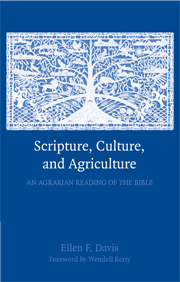 Perhaps a better way to say it isn't so much Christians should be organic, but be agrarian. Scripture, Culture and Agriculture has opened my eyes more to this perspective. I've been telling everyone that I have been wanting to read a book like this; one that looks at Scripture with an environmental hermeneutic, not simply pulling out verses here and there and then pulling them together for some sort of exhortation. Finally in this book I have it! Also, in some of my classes is an individual who majored in organic farming and shed light on the fact that its not about a healthy diet but how to treat the land, unfortunately most people don't look at it this way.
 Like I said, I've always leaned green; I've viewed the creation story in Genesis 1 as saying, among other things, that we should take better care of this planet. God has given us the task to "subdue the earth" and "rule over" all of the animals, but just before that it tells how God created humans in his own image. It says quite obviously that we are to subdue and rule in the way that God would. So the question I ask is, "How does God rule?" And the place that am brought to most easily is how God exercises dominion over humans... by serving them, doing everything he can for them to give them all of his glory and riches by going to the cross and suffering in their place.
The amazing thing about this book is that it goes way beyond that, it gets into Leviticus, among others books, and all the dietary laws and other laws that seem haphazardly put together and looks at them through this agrarian perspective. Most of what I have read so far I have really enjoyed reading. I'll admit in some places I feel like she's stretching the analogies and perhaps reading into something that's not there, but the overall view really works well. I would and I am recommending this book to people to gain a new perspective or develop one they already have.
The view that we should be living on this earth, by ensuring its well being and not ours. After all the world is God's and he has entrusted us to take care of it, unfortunately we mostly look at it as full of resources to be had, which s reflected in the way we farm, raise cattle, mine, etc. Christians should be intent on caring for this world better. Let's just thank God that he exercise dominion over us far better than we do over creation.
Friday, October 8, 2010
Mohler on Yoga and I disagree
http://www.albertmohler.com/2010/09/20/the-subtle-body-should-christians-practice-yoga/
http://www.albertmohler.com/2010/10/07/yahoo-yoga-and-yours-truly/
So Mohler recently wrote these articles on Yoga and how its unChristian, and how Christians who practice it are either teetering on the brink of post-modern pluralism, or teetering on the bring of apostasy, or they aren't really Christians. Maybe he wouldn't necessarily agree with the last two, but I think that he some what leans that way.
I do not disagree with what he says about yoga's background, indeed it is an historical spiritual practice, and everything about it that we practice is only based off of that. In that sense we are simply taking part in the religious practice of it, albeit ignorantly and not fully giving ourselves to it. I would also say his conclusion is correct, because of yoga's religious/spiritual nature Christians who practice it are taking part in another religious practice that directs its worship to another god(s). However, I disagree with his premise that because yoga and Christianity are in service to two different truths, that they are forever diametrically opposed.
Christianity has it fair share of ascetics, Simeon the Stylite for instance. Prayer and fasting are ascetics, they are simply means that we use to assist our focus on God. So, yoga as an ascetic practice is completely and totally viable, simply using the body and certain movements to clear one's mind to better meditate and focus on God. The whole idea of ascetic discipline is to train the body to allow one to clear their mind. We are created as physical beings; we should not abandon our physicalness for a solely mental spirituality. That to me sounds too much like gnosticism.
Therefore, I applaud the efforts of Christians who seek out some sort of physical discipline to help them focus and relax, I myself hike/backpack,do yoga, lift weights and sleep. (Ha! So maybe not the last one as a discipline, but it is an area of weakness and I wouldn't doubt my ability to serve God would be enhanced if I got more.) Humanity, Christians included, have a problem of letting life get in the way causing us to cast our eyes downward. So we need a time of solitude to disengage our attention on the world and enable us to focus our eyes up back on God. Of course reading Scripture is a great way to do this, prayer is as well, but those things alone are often very mental. Our Western, Greek Philosophy influenced, culture leaves out our physicalness, which is obviously important to our creatureliness, so luckily we have this connection to this eastern religious practice of yoga that can help.
Yoga, like fasting, I would say depends mostly on natural revelation, where as bible study and prayer depend mostly on special revelation. Now granted natural revelation without special revelation can be distorted and twisted. Of course special revelation itself can be distorted and twisted too without insights from natural revelation. But if I am to go through life dependent solely on one or the other, something is gravely missing. I am unable to truly experience God in all things if I do not take to heart natural revelation, and I am unable to experience him truly if I do not take to heart what special revelation says about natural revelation. All this to say, ascetic practices like yoga, hiking, fasting or running are ways to experience God through the body, they are diving into natural revelation, and through this one can fully rest in the Truth that comes through special revelation. When I hike I let go, I rest; I experience the Triune God in his glorious creation and it frees me (my mind and my body) to rest in my knowledge of his love and my redemption.
The primary point of contention as I see it, and I am pretty certain in this, is not so much of the physical aspect of yoga, it is the practice's historical direction to whatever other god that wasn't Yahweh, not to mention its tantric aspect. One cannot really practice yoga without diving into some aspect of this, if they do not dive in, then it simply becomes a workout. However, its not that black and white; one does not have to dive into this to fully appreciate the practice of yoga. Yoga's whole spirituality can be redeemed, after all it was created by man. It is simply the longing of individuals to reach out to something that which they know is there; they know it because they sense something in their heart, and they know it because they sense something in nature. Unfortunately, it was only directed to something other than God. Now, if one wants to say that once yoga becomes "redeemed" it no longer becomes yoga, but becomes something else entirely, I might say they have a point. Although, I could in turn say that this opens the door for saying that once humans experience the finality of their redemption then they are no longer human, but something else entirely because their sinful past has been done away with.
I cannot find fault for people who are trying to find a divine experience with the God they know from church through yoga. Yes, they may be diving into it not truly knowing what they are getting into, nor truly knowing what they could be opening themselves up to. But I do not find fault with them, I find fault with the staid, dull churches that pushed them there. We do not need to be cutting off the people who are trying to experience Jesus through yoga by telling them its not Christian to do so. No, what we need to be doing is fixing the Christianity that's not enabling them to experience "life abundantly". Perhaps they think church is dull and boring because they have sin and that inturn is making them deaf to the "words of life" they are hearing at church, but if their sin issue isn't being competently addressed by the church then where really is the problem?
http://www.albertmohler.com/2010/10/07/yahoo-yoga-and-yours-truly/
So Mohler recently wrote these articles on Yoga and how its unChristian, and how Christians who practice it are either teetering on the brink of post-modern pluralism, or teetering on the bring of apostasy, or they aren't really Christians. Maybe he wouldn't necessarily agree with the last two, but I think that he some what leans that way.
I do not disagree with what he says about yoga's background, indeed it is an historical spiritual practice, and everything about it that we practice is only based off of that. In that sense we are simply taking part in the religious practice of it, albeit ignorantly and not fully giving ourselves to it. I would also say his conclusion is correct, because of yoga's religious/spiritual nature Christians who practice it are taking part in another religious practice that directs its worship to another god(s). However, I disagree with his premise that because yoga and Christianity are in service to two different truths, that they are forever diametrically opposed.
Christianity has it fair share of ascetics, Simeon the Stylite for instance. Prayer and fasting are ascetics, they are simply means that we use to assist our focus on God. So, yoga as an ascetic practice is completely and totally viable, simply using the body and certain movements to clear one's mind to better meditate and focus on God. The whole idea of ascetic discipline is to train the body to allow one to clear their mind. We are created as physical beings; we should not abandon our physicalness for a solely mental spirituality. That to me sounds too much like gnosticism.
Therefore, I applaud the efforts of Christians who seek out some sort of physical discipline to help them focus and relax, I myself hike/backpack,do yoga, lift weights and sleep. (Ha! So maybe not the last one as a discipline, but it is an area of weakness and I wouldn't doubt my ability to serve God would be enhanced if I got more.) Humanity, Christians included, have a problem of letting life get in the way causing us to cast our eyes downward. So we need a time of solitude to disengage our attention on the world and enable us to focus our eyes up back on God. Of course reading Scripture is a great way to do this, prayer is as well, but those things alone are often very mental. Our Western, Greek Philosophy influenced, culture leaves out our physicalness, which is obviously important to our creatureliness, so luckily we have this connection to this eastern religious practice of yoga that can help.
Yoga, like fasting, I would say depends mostly on natural revelation, where as bible study and prayer depend mostly on special revelation. Now granted natural revelation without special revelation can be distorted and twisted. Of course special revelation itself can be distorted and twisted too without insights from natural revelation. But if I am to go through life dependent solely on one or the other, something is gravely missing. I am unable to truly experience God in all things if I do not take to heart natural revelation, and I am unable to experience him truly if I do not take to heart what special revelation says about natural revelation. All this to say, ascetic practices like yoga, hiking, fasting or running are ways to experience God through the body, they are diving into natural revelation, and through this one can fully rest in the Truth that comes through special revelation. When I hike I let go, I rest; I experience the Triune God in his glorious creation and it frees me (my mind and my body) to rest in my knowledge of his love and my redemption.
The primary point of contention as I see it, and I am pretty certain in this, is not so much of the physical aspect of yoga, it is the practice's historical direction to whatever other god that wasn't Yahweh, not to mention its tantric aspect. One cannot really practice yoga without diving into some aspect of this, if they do not dive in, then it simply becomes a workout. However, its not that black and white; one does not have to dive into this to fully appreciate the practice of yoga. Yoga's whole spirituality can be redeemed, after all it was created by man. It is simply the longing of individuals to reach out to something that which they know is there; they know it because they sense something in their heart, and they know it because they sense something in nature. Unfortunately, it was only directed to something other than God. Now, if one wants to say that once yoga becomes "redeemed" it no longer becomes yoga, but becomes something else entirely, I might say they have a point. Although, I could in turn say that this opens the door for saying that once humans experience the finality of their redemption then they are no longer human, but something else entirely because their sinful past has been done away with.
I cannot find fault for people who are trying to find a divine experience with the God they know from church through yoga. Yes, they may be diving into it not truly knowing what they are getting into, nor truly knowing what they could be opening themselves up to. But I do not find fault with them, I find fault with the staid, dull churches that pushed them there. We do not need to be cutting off the people who are trying to experience Jesus through yoga by telling them its not Christian to do so. No, what we need to be doing is fixing the Christianity that's not enabling them to experience "life abundantly". Perhaps they think church is dull and boring because they have sin and that inturn is making them deaf to the "words of life" they are hearing at church, but if their sin issue isn't being competently addressed by the church then where really is the problem?
Thursday, October 7, 2010
The Hypothesis: The Documents
So I just finished taking my first Old Testament exam in seminary; the documentary hypothesis factored into it heavily. And I have been wanting to get my thoughts down on something, be it paper or computer screen, about it for a while.
So my thoughts on the Documentary Hypothesis: Whatever. Ha! I guess that's just cause I'm a product if the last 5th of the 20th century. But in all seriousness, whatever. I don't think the documentary hypothesis is really that big of a deal, considering it wasn't until later, like the last half of the 20th century, that the literary approach to Scripture made any headway. If there wasn't an emphasis on a literary approach to reading Scripture in academia before that, then the hypothesis is working in a vacuum. I would think that working in such a vacuum gave it a lot more power and influence than had it been working alongside other theories, like now for instance. Not to mention that one of it main proponents was an anti-semite, anti Roman Catholic, so I would assume such a bias throws a little speculation into what he was actually trying to accomplish. Lets not forget as well that the documentary hypothesis is exactly that a hypothesis, it can most definitely be proven wrong, and with other theories about the formation of the Pentateuch circulating one has to pick which one they want, or how they want it. The biggest point with the fallibility of a hypothesis is that if it is wrong your interpretation based on that will be wrong as well, and if your interpretation is wrong then your application of that would be wrong. So essentially your theological framework is "at risk". (Although I must say, it might be at risk, but I doubt a significant portion would be at risk, and even still its an interpretation based on Scripture. So I would say there is an element of protection there by Providence, or so I would hope.)
Don't get me wrong, though. The theory has its strong points. It gives us a way to look at the world behind the writings. If the first creation account was written by the Priestly source, and the Priestly source was mainly a product of the exile, then we get a glimpse into the thought behind it, and an intended purpose to it. Or if the Elohist source was a product of the Northern Kingdom it can gives a picture into the why Aaron is cast in such a bad light. If the hypothesis is wrong though, then of course all the interpretations therein are wrong too.
I would prefer Brevard Child's approach of biblical theology. It's more of a canonical criticism, we have the Scripture as a whole, and that's how I think it should be dealt with. Sure insight can be made by the source backgrounds, but ultimately the sources are now together, they are a unified whole and should be interpreted through that lens as much, if not more so than any other. We have two creation accounts, one from the P source and another from the J, but we don't have them separately we have them together, what does that mean for our interpretation? We have Sodom and Gomorrah, the conquest of the land of Canaan and what some call genocide, but we also have the prophets, epistles and Jesus, so how do we put these things together in the grand story without becoming Marcionist/ites? (That is saying that the Old Testament God is one of wrath and completely different from the New Testament God of universal love. Marcion created his own canon and it was essentially Luke and Paul's Epistles.)
Ultimately, in the interpretation of the Scriptures I think its helpful to start from a firm foundation of belief and then pull from many different sources to fill out one's view. To limit oneself to one criticism or approach would really prevent one from growing and developing new views, or strengthening their own view. Its really a practice in formal operations, I would think, to put yourself in another hat, or pair of shoes and fully live that out for just a second. Such a practice can help one to grow in their theological understand, as well as their faith. Interpreting Scripture should be a challenge, and it should seem dangerous and uncomfortable, God is far bigger than one theological thought, or biblical studies approach can handle.
If we really dig into Scripture and only do so to affirm what we already believe what then are we doing? We are simply using Scripture as a dictionary or encyclopedia, a reference source for our knowledge, is that what we should do? I do not think so, not if we want to be corrected, trained, rebuked, and taught in righteousness.
One may have their own bias on theology and approach, I for instance like the canonical approach, and prefer Covenant Theology, but I must at least allow all that to be challenged. I may argue those views to be right, but I must allow the discussion to happen.
So my thoughts on the Documentary Hypothesis: Whatever. Ha! I guess that's just cause I'm a product if the last 5th of the 20th century. But in all seriousness, whatever. I don't think the documentary hypothesis is really that big of a deal, considering it wasn't until later, like the last half of the 20th century, that the literary approach to Scripture made any headway. If there wasn't an emphasis on a literary approach to reading Scripture in academia before that, then the hypothesis is working in a vacuum. I would think that working in such a vacuum gave it a lot more power and influence than had it been working alongside other theories, like now for instance. Not to mention that one of it main proponents was an anti-semite, anti Roman Catholic, so I would assume such a bias throws a little speculation into what he was actually trying to accomplish. Lets not forget as well that the documentary hypothesis is exactly that a hypothesis, it can most definitely be proven wrong, and with other theories about the formation of the Pentateuch circulating one has to pick which one they want, or how they want it. The biggest point with the fallibility of a hypothesis is that if it is wrong your interpretation based on that will be wrong as well, and if your interpretation is wrong then your application of that would be wrong. So essentially your theological framework is "at risk". (Although I must say, it might be at risk, but I doubt a significant portion would be at risk, and even still its an interpretation based on Scripture. So I would say there is an element of protection there by Providence, or so I would hope.)
Don't get me wrong, though. The theory has its strong points. It gives us a way to look at the world behind the writings. If the first creation account was written by the Priestly source, and the Priestly source was mainly a product of the exile, then we get a glimpse into the thought behind it, and an intended purpose to it. Or if the Elohist source was a product of the Northern Kingdom it can gives a picture into the why Aaron is cast in such a bad light. If the hypothesis is wrong though, then of course all the interpretations therein are wrong too.
I would prefer Brevard Child's approach of biblical theology. It's more of a canonical criticism, we have the Scripture as a whole, and that's how I think it should be dealt with. Sure insight can be made by the source backgrounds, but ultimately the sources are now together, they are a unified whole and should be interpreted through that lens as much, if not more so than any other. We have two creation accounts, one from the P source and another from the J, but we don't have them separately we have them together, what does that mean for our interpretation? We have Sodom and Gomorrah, the conquest of the land of Canaan and what some call genocide, but we also have the prophets, epistles and Jesus, so how do we put these things together in the grand story without becoming Marcionist/ites? (That is saying that the Old Testament God is one of wrath and completely different from the New Testament God of universal love. Marcion created his own canon and it was essentially Luke and Paul's Epistles.)
Ultimately, in the interpretation of the Scriptures I think its helpful to start from a firm foundation of belief and then pull from many different sources to fill out one's view. To limit oneself to one criticism or approach would really prevent one from growing and developing new views, or strengthening their own view. Its really a practice in formal operations, I would think, to put yourself in another hat, or pair of shoes and fully live that out for just a second. Such a practice can help one to grow in their theological understand, as well as their faith. Interpreting Scripture should be a challenge, and it should seem dangerous and uncomfortable, God is far bigger than one theological thought, or biblical studies approach can handle.
If we really dig into Scripture and only do so to affirm what we already believe what then are we doing? We are simply using Scripture as a dictionary or encyclopedia, a reference source for our knowledge, is that what we should do? I do not think so, not if we want to be corrected, trained, rebuked, and taught in righteousness.
One may have their own bias on theology and approach, I for instance like the canonical approach, and prefer Covenant Theology, but I must at least allow all that to be challenged. I may argue those views to be right, but I must allow the discussion to happen.
Thursday, September 30, 2010
from my OT class
So I have this Old Testament class, and we are going through the book of Genesis right now, and the professor mentioned the story of Abraham as being understood by some as allegorical, thus not real. He then posed the question "If Abraham didn't exist does that mean Christ didn't die?" Obviously this was to get those with a "traditional" or "conservative" theological stance to think (or annoyed). Well I'm always up for a challenge even though I don't think of myself as solely traditional or conservative. The question is interesting, though, because many in fact would argue that if we say one part of the Bible isn't historically factual that then has a direct correlation to the story of Christ and now the story of Christ becomes totally and completely untrue. I don't think it's necessarily that clear cut, but I am nonetheless piqued by what allegorical understandings can do to Scriptural interpretation and understanding.
I'm posting a copy of my response to the discussion board, but before I do that I must feel I must explain that it is indirectly responsive to the other two responses as well as the question. They argued, essentially, that there is a bigger theological understanding to the text, and the one can know Christ and experience transforming faith through him without having to worry about the nature of the Abraham's story. Now this view I understand, but mostly disagree with which is what my post is more about; I think the posed question is not dealing with how such a reading impacts of experience of God's power or one's faith. Therefore, I am more concerned with how such a reading impacts the whole flow and understanding of Scripture and the implications that a particular reading in one place has on another reading in another place. Also, this was literally an off the cuff sort of thing, so I must add that it is definitely lacking:
The story of Abraham doesn't correlate, necessarily, to whether or not Christ died, it does I believe correlate to the resurrection. The power and authority of the resurrection does not come solely from the story of Christ and the writings of the New Testament, but from the Old Testament and the story of Israel. The problem with understanding the stories such as Abraham in a new light is that you must understand that in light of how it can impact the story of Christ.
If we are to say that the story of Abraham is only allegorical it can be understood to be the express of humanity's longing for God to redeem his creation. The idea that God has an intent to bless the whole world. That God sees faith as our righteousness and not our actions. The idea that God will provide the offer, such as in the story of Isaac, that culminates in the Father doing with Christ for everyone which he would not let Abraham do only for himself. It can, however, run the risk of understanding the story of the resurrection in the same light. That resurrection doesn't actually happen, but it's allegorical, and as such expresses the human longing which we can experience through the story and lifestyle of Christ, which raises another issue in itself.
Another risk that a pure allegorical reading can render is that actuality of God's work. If the reading is purely allegorical then we cannot point to the work of Christ and say, "Look what God does for us!", and then point back to the story of Abraham and say, "See he's been actually doing it all along!" The allegorical reading sacrifices a sort of evidence that we can point to showing that not only has it long been humanity's longing, but God has long been fulfilling that longing. The allegorical reading cannot say that God hasn't been fulfilling our longing, but it can prevent us from showing a certain sense of "proof" of where and how he has done it.
I'm posting a copy of my response to the discussion board, but before I do that I must feel I must explain that it is indirectly responsive to the other two responses as well as the question. They argued, essentially, that there is a bigger theological understanding to the text, and the one can know Christ and experience transforming faith through him without having to worry about the nature of the Abraham's story. Now this view I understand, but mostly disagree with which is what my post is more about; I think the posed question is not dealing with how such a reading impacts of experience of God's power or one's faith. Therefore, I am more concerned with how such a reading impacts the whole flow and understanding of Scripture and the implications that a particular reading in one place has on another reading in another place. Also, this was literally an off the cuff sort of thing, so I must add that it is definitely lacking:
The story of Abraham doesn't correlate, necessarily, to whether or not Christ died, it does I believe correlate to the resurrection. The power and authority of the resurrection does not come solely from the story of Christ and the writings of the New Testament, but from the Old Testament and the story of Israel. The problem with understanding the stories such as Abraham in a new light is that you must understand that in light of how it can impact the story of Christ.
If we are to say that the story of Abraham is only allegorical it can be understood to be the express of humanity's longing for God to redeem his creation. The idea that God has an intent to bless the whole world. That God sees faith as our righteousness and not our actions. The idea that God will provide the offer, such as in the story of Isaac, that culminates in the Father doing with Christ for everyone which he would not let Abraham do only for himself. It can, however, run the risk of understanding the story of the resurrection in the same light. That resurrection doesn't actually happen, but it's allegorical, and as such expresses the human longing which we can experience through the story and lifestyle of Christ, which raises another issue in itself.
Another risk that a pure allegorical reading can render is that actuality of God's work. If the reading is purely allegorical then we cannot point to the work of Christ and say, "Look what God does for us!", and then point back to the story of Abraham and say, "See he's been actually doing it all along!" The allegorical reading sacrifices a sort of evidence that we can point to showing that not only has it long been humanity's longing, but God has long been fulfilling that longing. The allegorical reading cannot say that God hasn't been fulfilling our longing, but it can prevent us from showing a certain sense of "proof" of where and how he has done it.
Subscribe to:
Posts (Atom)