I mentioned earlier my view that the Bible as counter cultural; kt is concerned with the kingdom of God as opposed to our human kingdoms and cultures, whatever those may be. The Bible can be, and should be, an incredibly challenging document and we should be humble enough to open ourselves to its counter to our personal cultural affinities.
Yet as counter cultural as the Bible is, it is still incredibly cultured. It is a document that comes from humans and from human culture, not out of the sky and not merely through human penmanship Because of the "humanness" of Scripture its counter culturalness must often be found as it is not always often seen.
Showing posts with label Scripture. Show all posts
Showing posts with label Scripture. Show all posts
Thursday, July 19, 2012


Friday, June 22, 2012
from the bible to the counter culture
This is one of those thoughts that I thought a good while ago and then when I went to write it out I totally lost my train of thought. So, it's sat as an idea for over 7 months.
Then I began to have a conversation with my brother about his disdain for the cult of personality around Mark Driscoll and the theology being taught in a local Acts29 church plant. Maybe disdain is too strong a word, but he does have an aversion to it if only out of frustration. I'll admit I agree with him on a lot of his frustrations, but that's not the point of this post.
The point is the "counter-cultureness" or "otherness" of Scripture.
Then I began to have a conversation with my brother about his disdain for the cult of personality around Mark Driscoll and the theology being taught in a local Acts29 church plant. Maybe disdain is too strong a word, but he does have an aversion to it if only out of frustration. I'll admit I agree with him on a lot of his frustrations, but that's not the point of this post.
The point is the "counter-cultureness" or "otherness" of Scripture.
Friday, January 27, 2012
the devil

Tuesday, July 19, 2011
organic and cruelty free: God help me.

You can view that blog post here: christians should be organic and further thoughts on it here: further thoughts on agrarian
The process has been quite a challenging one. It's just a preference for me that I want simply because it sounds nice... its far more theological for me, I guess you could say its more of a conviction that I think I, as Christian, should eat organic. It's more than just nicer and cleaner, it's also more "right." That is, I think Scripture points towards a more ethical, not economic, treatment of the earth and Creation. (notice the globe... it means my view is holistic and cares for the earth... you know, typical)
Wednesday, July 13, 2011
God is like fireworks and vice versa
My mother says I think too much and too indepth about things.
Perhaps.
But it's hard not to.
I can't help but see beyond, be they outcomes or allegories, the thing which is presently at hand... whatever that may be. I am simply under the impression that there is always something more to everything; what I have right now points to something else and, as such, is somehow revelatory of something more.
For instance, a snide comment to my wife is not merely an isolated, rude remark. Its much bigger than that and, by knowing that, I am actually able to peer inside myself, able to know from what corner of my heart such a remark originates; perhaps then I can better know the motives of my heart that would form such a remark. Like wise, I see also in the possible future if such basal actions and instincts are not dealt with and to me it doesn't look pretty.
So having such an internal process... God and fireworks.
Perhaps.
But it's hard not to.
I can't help but see beyond, be they outcomes or allegories, the thing which is presently at hand... whatever that may be. I am simply under the impression that there is always something more to everything; what I have right now points to something else and, as such, is somehow revelatory of something more.
For instance, a snide comment to my wife is not merely an isolated, rude remark. Its much bigger than that and, by knowing that, I am actually able to peer inside myself, able to know from what corner of my heart such a remark originates; perhaps then I can better know the motives of my heart that would form such a remark. Like wise, I see also in the possible future if such basal actions and instincts are not dealt with and to me it doesn't look pretty.
So having such an internal process... God and fireworks.
Friday, March 4, 2011
Reading of Scripture and Love Wins
So having a friend who went to Rob Bell's church, I myself liking Rob Bell, being a Christian, being in seminary and being rather familiar with the conservative, evangelicalsI have been not far from the debate about Rob Bell's new book Love Wins.
 Personally, I'm not much concerned about what he is saying right now; he has a new book coming out, which is sold by a publisher, a big one at that; publishers have to make money and so they hire marketing firms. If I were a marketing firm and I wanted to sell a book... I'd make controversy or get good reviews. Well, in the Christian world good reviews sell well, especially the classics, but nothing sells like an out in the open theological controversy; therefore, if I were a marketer I would make a controversy and props to HarperOne cause that's what they got and I guarantee you that everyone will either buy the book or borrow it; I mean they practically have to now if they care anything about the debate that is now in the public sphere.
 Personally, I'm not much concerned about what he is saying right now; he has a new book coming out, which is sold by a publisher, a big one at that; publishers have to make money and so they hire marketing firms. If I were a marketing firm and I wanted to sell a book... I'd make controversy or get good reviews. Well, in the Christian world good reviews sell well, especially the classics, but nothing sells like an out in the open theological controversy; therefore, if I were a marketer I would make a controversy and props to HarperOne cause that's what they got and I guarantee you that everyone will either buy the book or borrow it; I mean they practically have to now if they care anything about the debate that is now in the public sphere.
Tuesday, January 25, 2011
fear good
So I am scared of my future, it’s really no big deal.
In fact, I’m glad to say that I am, at least I’m a realist. I don’t think we are honest enough with fear. It’s like we want to cover it up, as if it’s bad. There seems to be something wrong with crying out and admitting to fear. We really are a bunch of liars; we go around showing strength and fortitude, and yet we are crying for answers and certainty.
For my Old Testament class we have to read all of the Psalms.
Wednesday, January 12, 2011
cold turkey ain't good turkey
One of the things that I am really against is cold turkey evangelism. I’ve done enough times to know that I don’t like it. Of course the argument for it is that you do it with the trust that God will somehow use it for his purposes. I agree with that, and when I do evangelize I am taking that to heart.
My problem is that it is simply a bad way to evangelize. It is wrought of love. Now of course I know that even taking the time to tell them about the Lordship of Christ is loving for me to do, but honestly how loved do they feel? If all I do is come up and share the gospel with them and then leave them at that what love would they feel? Would they feel loved that I took the time to come up to them to talk to them about Jesus? Maybe… if they were already Christian, but if they don’t know Christ yet then what? If it’s without some sort of continuing relationship what love is really given?
Loving should go hand in hand with suffering, and there is no suffering in cold turkey evangelism, there is persecution, but not the long suffering that Christ experienced. He spent 3 years with his disciples only to die without them "getting it" until he rose. That’s suffering, that expending yourself and not seeing any fruit. This is the sort of suffering that relational evangelism brings, not cold turkey. We should expect, and desire, to spend time with people, watch them sin, and never get it. We should expect them to deny Christ, turn away, make grandiose statements about his divinity and then in the next second be against Christ’s work. That suffering is much worse than merely being spat upon, that suffering breaks hearts.
I’d be willing to say that that is the model of evangelism that is set up for us. The gospel isn’t about getting people to convert, it’s about the Lordship of Christ enabling us to truly love and serve God, and, if we are doing that faithfully, conversion will happen whether we want it to or not. Just going out and throwing out the Word randomly is bad stewardship to. A farmer sure as heck doesn’t just randomly scatter seed, he does it with purpose and intent, some may fall on the path, but he is sowing seed in the field where he will be sure to tend to it.
We do have to proclaim it, but it’s different proclaiming a Messiah to people who are looking for one than to people who think they are their own Messiah. And if we are to proclaim it, it should be in the community that we live amongst, that we will be around daily or weekly, not to random people on the beach or a street that we probably will never see again.
Wednesday, December 15, 2010
turn it inside out
Christmas is awesome.
I love Christmas. I love Christmas music, and I love Christmas cheer, and "the best way to spread Christmas cheer is by singing loud for all to hear"- Elf.
I also love Christmas for the fact of little baby Jesus. Yes, he is our savior and that is way totally awesome, but it is so much deeper than that. It's ridiculous when you actually think about Christmas, like what went on. It's not just that Jesus was born, but it's that Jesus was born... am I confusing you?
Let me put it like this, Jesus, Son of God and God incarnate, was born as a human. That is impressive, and I think some get it, but many people don't get it. Pithy phrases like "Jesus is the reason for the season" just don't capture it. Most have this idea of Jesus being born in a barn to ultimately die for the redemption of humanity and this other idea of Jesus being one with the Father, and they never put two and two together.
This one thing has really been sticking out more and more to me lately, the sheer contradiction of Jesus a human and God a not-human. When God comes into this world as Jesus, God essentially became not-God. Think of it, God is omnipotent, omniscient, omnipresent, holy and glorious. Jesus is finite in everyone of those areas, he had finite power, finite knowledge, finite presence, was born and raised not by a priestly family of affluence, but by an poorer carpenter family - there's is nothing holy and glorious about that. The climax of the life of Jesus is even more ridiculous, he becomes sin; there is nothing more opposite of God than that. God came to earth as Jesus to essentially not be himself, not just be not himself, but the polar opposite.
This is not to say that Jesus couldn't have been more like a deity. Jesus most definitely had the capabilities, but Phil. 2:6 puts it like this "though being in the form of God, did not count equality with God a thing to be grasped." INCREDIBLE! Think of what Jesus could have been, but what Jesus was. He could have called on the angels to rescue him, but he didn't. He could have.... done well pretty much anything to make him more glorious, and yet he didn't. He remained a humble servant of not only God, but of humanity... the most high God became the most humble of creatures, and not only that but served them and is the sacrifice for them as well.
I just think its incredible that God turned himself inside out for us. He not only bent over backwards, but became not-God, he became opposite his nature and character just to rescue us. Why? It'd be like me becoming last so that I may be first, or leaving 99 sheep to find one. It is illogical and stupid, and yet its what God has done. God went off and got illogical; he became the very opposite of everything he was to open the gates of the kingdom for sinners like me.
I love Christmas. I love Christmas music, and I love Christmas cheer, and "the best way to spread Christmas cheer is by singing loud for all to hear"- Elf.
I also love Christmas for the fact of little baby Jesus. Yes, he is our savior and that is way totally awesome, but it is so much deeper than that. It's ridiculous when you actually think about Christmas, like what went on. It's not just that Jesus was born, but it's that Jesus was born... am I confusing you?
Let me put it like this, Jesus, Son of God and God incarnate, was born as a human. That is impressive, and I think some get it, but many people don't get it. Pithy phrases like "Jesus is the reason for the season" just don't capture it. Most have this idea of Jesus being born in a barn to ultimately die for the redemption of humanity and this other idea of Jesus being one with the Father, and they never put two and two together.
This one thing has really been sticking out more and more to me lately, the sheer contradiction of Jesus a human and God a not-human. When God comes into this world as Jesus, God essentially became not-God. Think of it, God is omnipotent, omniscient, omnipresent, holy and glorious. Jesus is finite in everyone of those areas, he had finite power, finite knowledge, finite presence, was born and raised not by a priestly family of affluence, but by an poorer carpenter family - there's is nothing holy and glorious about that. The climax of the life of Jesus is even more ridiculous, he becomes sin; there is nothing more opposite of God than that. God came to earth as Jesus to essentially not be himself, not just be not himself, but the polar opposite.
This is not to say that Jesus couldn't have been more like a deity. Jesus most definitely had the capabilities, but Phil. 2:6 puts it like this "though being in the form of God, did not count equality with God a thing to be grasped." INCREDIBLE! Think of what Jesus could have been, but what Jesus was. He could have called on the angels to rescue him, but he didn't. He could have.... done well pretty much anything to make him more glorious, and yet he didn't. He remained a humble servant of not only God, but of humanity... the most high God became the most humble of creatures, and not only that but served them and is the sacrifice for them as well.
I just think its incredible that God turned himself inside out for us. He not only bent over backwards, but became not-God, he became opposite his nature and character just to rescue us. Why? It'd be like me becoming last so that I may be first, or leaving 99 sheep to find one. It is illogical and stupid, and yet its what God has done. God went off and got illogical; he became the very opposite of everything he was to open the gates of the kingdom for sinners like me.
Saturday, December 4, 2010
half of my heart
No I'm not thinking of the John Mayer song, but I do like it. And if you're like me once you get a thought of something in your head you just have to get that taken care of. So here, enjoy Half of My Heart by John Mayer:
I was praying through Jeremiah 29:11-14 and this idea of only seeking God with half of my heart hit me hard. Most often when you look into this passage, only verse 11 sticks out, "For I know the plans I have for you, declares the LORD, plans for welfare and not for evil, to give you a future and a hope." When I first started praying through it, that was what hit me too, but then I verse 13 really started sticking out to me, "You will seek me and find me, when you seek me with all your heart."
The word translated as heart in the original Hebrew is lebab; it means something far more than what we mean when we speak of heart. Heart to us is a strong feeling of emotion, some might call it soul, but it does not connote much more than strong feelings and desires. "I give you my heart," is an example where we are giving all of our emotions and feelings to someone. Lebab on the other hand is far more than that; it is more along the lines of whole being, heart, soul, emotions, thoughts, mind, etc. Everything that someone is is their lebab.
Luckily, I knew this fact going in and it really opened my eyes. I often speak of the pride I find in my knowledge, and it yet again rears its ugly head here. I am only throwing half of my heart in my quest for God more often than not. I find that when I seek, it is mostly a thought processes: a question of why or how something is, concluding in understanding. Rarely is it a emotive or physical process, and when it is those, rarely is it ever holistic, it's always either/or. This enlightenment frustrates me. One of my greatest strengths is even more so one of my greatest faults.
This does have a silver lining though; in seminary, I am at a place where thinking takes a high priority, and so when I am wanting to meet God I simply don't want to do a study or think more. I am already exhausted of thinking. What I find myself wanting to do is rest and enjoy - a very physical and emotional thing I have found. And thankfully my prayer life in this and for this is being blessed.
I wonder though if this is something that will stick with me or if I will default back to my faulty asset. This is a fear of mine I admit. I do not want to keep seeking God with half of my heart, because I simply will not fully find him. I want to seek God with everything so that I can truly enjoy everything of him. There is a delight that I am finding right now in seeking God with more than my mind through some sort of Scripture study. This is something that I want to maintain, and whereas I have my fears I also know that God is faithful.
I was praying through Jeremiah 29:11-14 and this idea of only seeking God with half of my heart hit me hard. Most often when you look into this passage, only verse 11 sticks out, "For I know the plans I have for you, declares the LORD, plans for welfare and not for evil, to give you a future and a hope." When I first started praying through it, that was what hit me too, but then I verse 13 really started sticking out to me, "You will seek me and find me, when you seek me with all your heart."
The word translated as heart in the original Hebrew is lebab; it means something far more than what we mean when we speak of heart. Heart to us is a strong feeling of emotion, some might call it soul, but it does not connote much more than strong feelings and desires. "I give you my heart," is an example where we are giving all of our emotions and feelings to someone. Lebab on the other hand is far more than that; it is more along the lines of whole being, heart, soul, emotions, thoughts, mind, etc. Everything that someone is is their lebab.
Luckily, I knew this fact going in and it really opened my eyes. I often speak of the pride I find in my knowledge, and it yet again rears its ugly head here. I am only throwing half of my heart in my quest for God more often than not. I find that when I seek, it is mostly a thought processes: a question of why or how something is, concluding in understanding. Rarely is it a emotive or physical process, and when it is those, rarely is it ever holistic, it's always either/or. This enlightenment frustrates me. One of my greatest strengths is even more so one of my greatest faults.
This does have a silver lining though; in seminary, I am at a place where thinking takes a high priority, and so when I am wanting to meet God I simply don't want to do a study or think more. I am already exhausted of thinking. What I find myself wanting to do is rest and enjoy - a very physical and emotional thing I have found. And thankfully my prayer life in this and for this is being blessed.
I wonder though if this is something that will stick with me or if I will default back to my faulty asset. This is a fear of mine I admit. I do not want to keep seeking God with half of my heart, because I simply will not fully find him. I want to seek God with everything so that I can truly enjoy everything of him. There is a delight that I am finding right now in seeking God with more than my mind through some sort of Scripture study. This is something that I want to maintain, and whereas I have my fears I also know that God is faithful.
Tuesday, November 2, 2010
Christians should be organic.
This is a relatively new view for me. I mean I've always leaned toward the green perspective due to my parents leaning that way, but I've always kind of seen the whole organic thing as a healthy diet type of thing, not really as a way of viewing the world. And so discredited it.
 Perhaps a better way to say it isn't so much Christians should be organic, but be agrarian. Scripture, Culture and Agriculture has opened my eyes more to this perspective. I've been telling everyone that I have been wanting to read a book like this; one that looks at Scripture with an environmental hermeneutic, not simply pulling out verses here and there and then pulling them together for some sort of exhortation. Finally in this book I have it! Also, in some of my classes is an individual who majored in organic farming and shed light on the fact that its not about a healthy diet but how to treat the land, unfortunately most people don't look at it this way.
Like I said, I've always leaned green; I've viewed the creation story in Genesis 1 as saying, among other things, that we should take better care of this planet. God has given us the task to "subdue the earth" and "rule over" all of the animals, but just before that it tells how God created humans in his own image. It says quite obviously that we are to subdue and rule in the way that God would. So the question I ask is, "How does God rule?" And the place that am brought to most easily is how God exercises dominion over humans... by serving them, doing everything he can for them to give them all of his glory and riches by going to the cross and suffering in their place.
The amazing thing about this book is that it goes way beyond that, it gets into Leviticus, among others books, and all the dietary laws and other laws that seem haphazardly put together and looks at them through this agrarian perspective. Most of what I have read so far I have really enjoyed reading. I'll admit in some places I feel like she's stretching the analogies and perhaps reading into something that's not there, but the overall view really works well. I would and I am recommending this book to people to gain a new perspective or develop one they already have.
The view that we should be living on this earth, by ensuring its well being and not ours. After all the world is God's and he has entrusted us to take care of it, unfortunately we mostly look at it as full of resources to be had, which s reflected in the way we farm, raise cattle, mine, etc. Christians should be intent on caring for this world better. Let's just thank God that he exercise dominion over us far better than we do over creation.
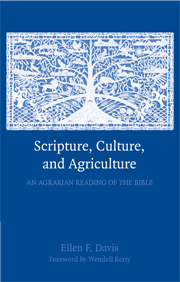 Perhaps a better way to say it isn't so much Christians should be organic, but be agrarian. Scripture, Culture and Agriculture has opened my eyes more to this perspective. I've been telling everyone that I have been wanting to read a book like this; one that looks at Scripture with an environmental hermeneutic, not simply pulling out verses here and there and then pulling them together for some sort of exhortation. Finally in this book I have it! Also, in some of my classes is an individual who majored in organic farming and shed light on the fact that its not about a healthy diet but how to treat the land, unfortunately most people don't look at it this way.
 Like I said, I've always leaned green; I've viewed the creation story in Genesis 1 as saying, among other things, that we should take better care of this planet. God has given us the task to "subdue the earth" and "rule over" all of the animals, but just before that it tells how God created humans in his own image. It says quite obviously that we are to subdue and rule in the way that God would. So the question I ask is, "How does God rule?" And the place that am brought to most easily is how God exercises dominion over humans... by serving them, doing everything he can for them to give them all of his glory and riches by going to the cross and suffering in their place.
The amazing thing about this book is that it goes way beyond that, it gets into Leviticus, among others books, and all the dietary laws and other laws that seem haphazardly put together and looks at them through this agrarian perspective. Most of what I have read so far I have really enjoyed reading. I'll admit in some places I feel like she's stretching the analogies and perhaps reading into something that's not there, but the overall view really works well. I would and I am recommending this book to people to gain a new perspective or develop one they already have.
The view that we should be living on this earth, by ensuring its well being and not ours. After all the world is God's and he has entrusted us to take care of it, unfortunately we mostly look at it as full of resources to be had, which s reflected in the way we farm, raise cattle, mine, etc. Christians should be intent on caring for this world better. Let's just thank God that he exercise dominion over us far better than we do over creation.
Thursday, October 7, 2010
The Hypothesis: The Documents
So I just finished taking my first Old Testament exam in seminary; the documentary hypothesis factored into it heavily. And I have been wanting to get my thoughts down on something, be it paper or computer screen, about it for a while.
So my thoughts on the Documentary Hypothesis: Whatever. Ha! I guess that's just cause I'm a product if the last 5th of the 20th century. But in all seriousness, whatever. I don't think the documentary hypothesis is really that big of a deal, considering it wasn't until later, like the last half of the 20th century, that the literary approach to Scripture made any headway. If there wasn't an emphasis on a literary approach to reading Scripture in academia before that, then the hypothesis is working in a vacuum. I would think that working in such a vacuum gave it a lot more power and influence than had it been working alongside other theories, like now for instance. Not to mention that one of it main proponents was an anti-semite, anti Roman Catholic, so I would assume such a bias throws a little speculation into what he was actually trying to accomplish. Lets not forget as well that the documentary hypothesis is exactly that a hypothesis, it can most definitely be proven wrong, and with other theories about the formation of the Pentateuch circulating one has to pick which one they want, or how they want it. The biggest point with the fallibility of a hypothesis is that if it is wrong your interpretation based on that will be wrong as well, and if your interpretation is wrong then your application of that would be wrong. So essentially your theological framework is "at risk". (Although I must say, it might be at risk, but I doubt a significant portion would be at risk, and even still its an interpretation based on Scripture. So I would say there is an element of protection there by Providence, or so I would hope.)
Don't get me wrong, though. The theory has its strong points. It gives us a way to look at the world behind the writings. If the first creation account was written by the Priestly source, and the Priestly source was mainly a product of the exile, then we get a glimpse into the thought behind it, and an intended purpose to it. Or if the Elohist source was a product of the Northern Kingdom it can gives a picture into the why Aaron is cast in such a bad light. If the hypothesis is wrong though, then of course all the interpretations therein are wrong too.
I would prefer Brevard Child's approach of biblical theology. It's more of a canonical criticism, we have the Scripture as a whole, and that's how I think it should be dealt with. Sure insight can be made by the source backgrounds, but ultimately the sources are now together, they are a unified whole and should be interpreted through that lens as much, if not more so than any other. We have two creation accounts, one from the P source and another from the J, but we don't have them separately we have them together, what does that mean for our interpretation? We have Sodom and Gomorrah, the conquest of the land of Canaan and what some call genocide, but we also have the prophets, epistles and Jesus, so how do we put these things together in the grand story without becoming Marcionist/ites? (That is saying that the Old Testament God is one of wrath and completely different from the New Testament God of universal love. Marcion created his own canon and it was essentially Luke and Paul's Epistles.)
Ultimately, in the interpretation of the Scriptures I think its helpful to start from a firm foundation of belief and then pull from many different sources to fill out one's view. To limit oneself to one criticism or approach would really prevent one from growing and developing new views, or strengthening their own view. Its really a practice in formal operations, I would think, to put yourself in another hat, or pair of shoes and fully live that out for just a second. Such a practice can help one to grow in their theological understand, as well as their faith. Interpreting Scripture should be a challenge, and it should seem dangerous and uncomfortable, God is far bigger than one theological thought, or biblical studies approach can handle.
If we really dig into Scripture and only do so to affirm what we already believe what then are we doing? We are simply using Scripture as a dictionary or encyclopedia, a reference source for our knowledge, is that what we should do? I do not think so, not if we want to be corrected, trained, rebuked, and taught in righteousness.
One may have their own bias on theology and approach, I for instance like the canonical approach, and prefer Covenant Theology, but I must at least allow all that to be challenged. I may argue those views to be right, but I must allow the discussion to happen.
So my thoughts on the Documentary Hypothesis: Whatever. Ha! I guess that's just cause I'm a product if the last 5th of the 20th century. But in all seriousness, whatever. I don't think the documentary hypothesis is really that big of a deal, considering it wasn't until later, like the last half of the 20th century, that the literary approach to Scripture made any headway. If there wasn't an emphasis on a literary approach to reading Scripture in academia before that, then the hypothesis is working in a vacuum. I would think that working in such a vacuum gave it a lot more power and influence than had it been working alongside other theories, like now for instance. Not to mention that one of it main proponents was an anti-semite, anti Roman Catholic, so I would assume such a bias throws a little speculation into what he was actually trying to accomplish. Lets not forget as well that the documentary hypothesis is exactly that a hypothesis, it can most definitely be proven wrong, and with other theories about the formation of the Pentateuch circulating one has to pick which one they want, or how they want it. The biggest point with the fallibility of a hypothesis is that if it is wrong your interpretation based on that will be wrong as well, and if your interpretation is wrong then your application of that would be wrong. So essentially your theological framework is "at risk". (Although I must say, it might be at risk, but I doubt a significant portion would be at risk, and even still its an interpretation based on Scripture. So I would say there is an element of protection there by Providence, or so I would hope.)
Don't get me wrong, though. The theory has its strong points. It gives us a way to look at the world behind the writings. If the first creation account was written by the Priestly source, and the Priestly source was mainly a product of the exile, then we get a glimpse into the thought behind it, and an intended purpose to it. Or if the Elohist source was a product of the Northern Kingdom it can gives a picture into the why Aaron is cast in such a bad light. If the hypothesis is wrong though, then of course all the interpretations therein are wrong too.
I would prefer Brevard Child's approach of biblical theology. It's more of a canonical criticism, we have the Scripture as a whole, and that's how I think it should be dealt with. Sure insight can be made by the source backgrounds, but ultimately the sources are now together, they are a unified whole and should be interpreted through that lens as much, if not more so than any other. We have two creation accounts, one from the P source and another from the J, but we don't have them separately we have them together, what does that mean for our interpretation? We have Sodom and Gomorrah, the conquest of the land of Canaan and what some call genocide, but we also have the prophets, epistles and Jesus, so how do we put these things together in the grand story without becoming Marcionist/ites? (That is saying that the Old Testament God is one of wrath and completely different from the New Testament God of universal love. Marcion created his own canon and it was essentially Luke and Paul's Epistles.)
Ultimately, in the interpretation of the Scriptures I think its helpful to start from a firm foundation of belief and then pull from many different sources to fill out one's view. To limit oneself to one criticism or approach would really prevent one from growing and developing new views, or strengthening their own view. Its really a practice in formal operations, I would think, to put yourself in another hat, or pair of shoes and fully live that out for just a second. Such a practice can help one to grow in their theological understand, as well as their faith. Interpreting Scripture should be a challenge, and it should seem dangerous and uncomfortable, God is far bigger than one theological thought, or biblical studies approach can handle.
If we really dig into Scripture and only do so to affirm what we already believe what then are we doing? We are simply using Scripture as a dictionary or encyclopedia, a reference source for our knowledge, is that what we should do? I do not think so, not if we want to be corrected, trained, rebuked, and taught in righteousness.
One may have their own bias on theology and approach, I for instance like the canonical approach, and prefer Covenant Theology, but I must at least allow all that to be challenged. I may argue those views to be right, but I must allow the discussion to happen.
Thursday, September 30, 2010
from my OT class
So I have this Old Testament class, and we are going through the book of Genesis right now, and the professor mentioned the story of Abraham as being understood by some as allegorical, thus not real. He then posed the question "If Abraham didn't exist does that mean Christ didn't die?" Obviously this was to get those with a "traditional" or "conservative" theological stance to think (or annoyed). Well I'm always up for a challenge even though I don't think of myself as solely traditional or conservative. The question is interesting, though, because many in fact would argue that if we say one part of the Bible isn't historically factual that then has a direct correlation to the story of Christ and now the story of Christ becomes totally and completely untrue. I don't think it's necessarily that clear cut, but I am nonetheless piqued by what allegorical understandings can do to Scriptural interpretation and understanding.
I'm posting a copy of my response to the discussion board, but before I do that I must feel I must explain that it is indirectly responsive to the other two responses as well as the question. They argued, essentially, that there is a bigger theological understanding to the text, and the one can know Christ and experience transforming faith through him without having to worry about the nature of the Abraham's story. Now this view I understand, but mostly disagree with which is what my post is more about; I think the posed question is not dealing with how such a reading impacts of experience of God's power or one's faith. Therefore, I am more concerned with how such a reading impacts the whole flow and understanding of Scripture and the implications that a particular reading in one place has on another reading in another place. Also, this was literally an off the cuff sort of thing, so I must add that it is definitely lacking:
The story of Abraham doesn't correlate, necessarily, to whether or not Christ died, it does I believe correlate to the resurrection. The power and authority of the resurrection does not come solely from the story of Christ and the writings of the New Testament, but from the Old Testament and the story of Israel. The problem with understanding the stories such as Abraham in a new light is that you must understand that in light of how it can impact the story of Christ.
If we are to say that the story of Abraham is only allegorical it can be understood to be the express of humanity's longing for God to redeem his creation. The idea that God has an intent to bless the whole world. That God sees faith as our righteousness and not our actions. The idea that God will provide the offer, such as in the story of Isaac, that culminates in the Father doing with Christ for everyone which he would not let Abraham do only for himself. It can, however, run the risk of understanding the story of the resurrection in the same light. That resurrection doesn't actually happen, but it's allegorical, and as such expresses the human longing which we can experience through the story and lifestyle of Christ, which raises another issue in itself.
Another risk that a pure allegorical reading can render is that actuality of God's work. If the reading is purely allegorical then we cannot point to the work of Christ and say, "Look what God does for us!", and then point back to the story of Abraham and say, "See he's been actually doing it all along!" The allegorical reading sacrifices a sort of evidence that we can point to showing that not only has it long been humanity's longing, but God has long been fulfilling that longing. The allegorical reading cannot say that God hasn't been fulfilling our longing, but it can prevent us from showing a certain sense of "proof" of where and how he has done it.
I'm posting a copy of my response to the discussion board, but before I do that I must feel I must explain that it is indirectly responsive to the other two responses as well as the question. They argued, essentially, that there is a bigger theological understanding to the text, and the one can know Christ and experience transforming faith through him without having to worry about the nature of the Abraham's story. Now this view I understand, but mostly disagree with which is what my post is more about; I think the posed question is not dealing with how such a reading impacts of experience of God's power or one's faith. Therefore, I am more concerned with how such a reading impacts the whole flow and understanding of Scripture and the implications that a particular reading in one place has on another reading in another place. Also, this was literally an off the cuff sort of thing, so I must add that it is definitely lacking:
The story of Abraham doesn't correlate, necessarily, to whether or not Christ died, it does I believe correlate to the resurrection. The power and authority of the resurrection does not come solely from the story of Christ and the writings of the New Testament, but from the Old Testament and the story of Israel. The problem with understanding the stories such as Abraham in a new light is that you must understand that in light of how it can impact the story of Christ.
If we are to say that the story of Abraham is only allegorical it can be understood to be the express of humanity's longing for God to redeem his creation. The idea that God has an intent to bless the whole world. That God sees faith as our righteousness and not our actions. The idea that God will provide the offer, such as in the story of Isaac, that culminates in the Father doing with Christ for everyone which he would not let Abraham do only for himself. It can, however, run the risk of understanding the story of the resurrection in the same light. That resurrection doesn't actually happen, but it's allegorical, and as such expresses the human longing which we can experience through the story and lifestyle of Christ, which raises another issue in itself.
Another risk that a pure allegorical reading can render is that actuality of God's work. If the reading is purely allegorical then we cannot point to the work of Christ and say, "Look what God does for us!", and then point back to the story of Abraham and say, "See he's been actually doing it all along!" The allegorical reading sacrifices a sort of evidence that we can point to showing that not only has it long been humanity's longing, but God has long been fulfilling that longing. The allegorical reading cannot say that God hasn't been fulfilling our longing, but it can prevent us from showing a certain sense of "proof" of where and how he has done it.
Subscribe to:
Posts (Atom)